
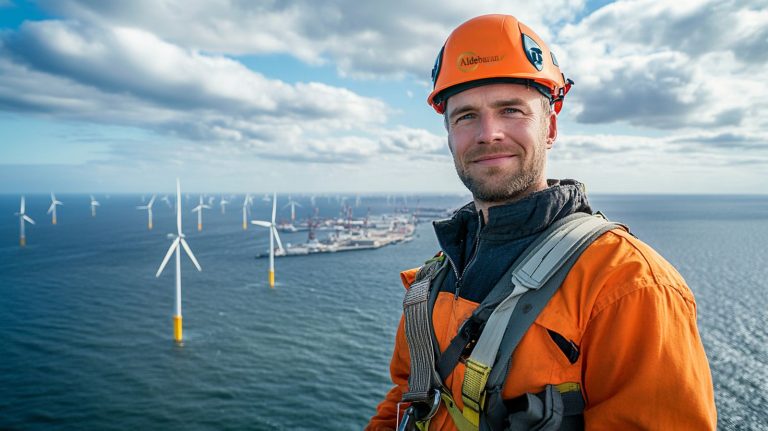
The silent revolution of offshore wind turbines: how RTE is rising to the colossal challenge of connecting 45 GW by 2050
France is writing a new chapter in its energy transition with offshore wind power, a key pillar for achieving carbon neutrality by 2050. Yet behind the massive turbines rising from the waves lies an equally complex infrastructure: the electrical grid tasked with connecting them to the mainland. With an ambitious goal of 45 gigawatts (GW) installed by 2050—six times the current capacity in just 25 years—RTE, France’s electricity transmission system operator, faces an unprecedented challenge. This is not just about the power generated, but about the ability to transport that energy across thousands of kilometers of submarine cables, through often hostile seabeds, while meeting increasingly strict environmental, geological, and social constraints. The cost of this infrastructure accounts for 30% to 40% of the total budget for offshore wind farms, representing a colossal sum estimated between €22 and €37 billion in 2024 constant terms. An investment that places schedule control on par with electricity production itself, as delays in grid connections could jeopardize the entire national energy strategy. Between technical innovation, process industrialization, and adaptation to local specifics, RTE must reinvent the way it works to reconcile climate ambition with economic viability.
French offshore wind power reached a historic milestone on April 10 with the commissioning of the first three floating turbines of the EFGL project, located 16 kilometers off the coast of Fos-sur-Mer in the Bouches-du-Rhône. These installations, approved under a Mediterranean tender, mark the completion of an initial cycle of nine wind farms from the first multiannual energy plan (PPE1) of 2016. Their connection required an investment of €1.6 billion for a total capacity of 3 GW, a cost and timeline that already offer a glimpse of the challenges ahead. For France’s ambitions are far greater: 18 GW by 2037, 26 GW by 2040, and at least 45 GW by 2050. To achieve this, it will not only be necessary to build hundreds of turbines, but also to deploy thousands of kilometers of submarine cables and dozens of transformer stations, all while meeting strict environmental standards and securing local stakeholder buy-in. Each project presents unique challenges, such as the Dieppe-Le Tréport wind farm, where the cable landing zone is at the foot of a steep cliff, requiring repeated technical adaptations to prevent landslides and ensure installation stability. These geological constraints, combined with ecological requirements and local resistance—particularly from fishermen—complicate every stage of the process. In Fécamp, for example, cable routes had to be revised to minimize impacts on fishing activities, illustrating the need for a collaborative approach with stakeholders. These examples show that project success depends not only on technology, but also on the ability to integrate ground realities from the design phase.
To meet this titanic challenge, RTE has developed a strategy dubbed “SMS,” an acronym for “standardization, massification, simplification.” The core idea is to transform artisanal processes into an industrial production line, where each step is optimized for efficiency and repeatability. Standardizing components, such as cables or electrical substations, would reduce manufacturing and maintenance costs, while mass ordering would give industrial players the visibility needed to invest in large-scale production tools. Finally, simplifying administrative and technical procedures aims to avoid costly back-and-forth between stakeholders, a recurring issue that has already delayed several projects. This approach draws on lessons from early wind farms, where design flaws or unforeseen issues led to budget overruns and delays. For instance, difficulties encountered during cable installation in steep areas led to the development of modular solutions adaptable to different seabed types. Similarly, managing conflicting uses, such as tensions between wind developers and fishermen, has evolved toward more transparent compromises that integrate local constraints from the outset. While these adjustments may seem time-consuming at first, they should streamline future projects and reduce the risk of blockages. Yet this strategy hinges on a crucial assumption: the ability to quickly launch the necessary tenders to trigger orders. The third multiannual energy plan (PPE3), published in February, calls for two massive tenders—AO9 and AO10—totaling 12.5 GW. But to date, no precise timeline has been announced, leaving RTE “navigating blind.” Without visibility on actual volumes to connect, the operator risks facing a paradoxical situation: having the infrastructure to produce electricity but lacking the means to transport it. This uncertainty weighs on the entire sector, which is eagerly awaiting clarifications to adjust its own equipment and human resource investments.
The stakes of offshore wind power extend far beyond technical or financial questions. While this technology is often touted as a miracle solution for decarbonizing France’s energy mix, its success hinges on overcoming challenges of unprecedented scale. The targets set by PPE3—45 GW by 2050—align with IPCC scenarios, which estimate that offshore wind could supply up to 20% of global electricity demand by mid-century. Yet to achieve this, France must not only erect hundreds of turbines, but also deploy thousands of kilometers of submarine cables and dozens of transformer stations, all while meeting strict environmental standards and securing public support. The risks are manifold: delays in grid connections could lead to massive cost overruns, while overly rapid industrialization might overlook local specifics, fueling opposition. Conversely, an overly cautious approach could stifle innovation and cede ground to better-organized foreign competitors. In this context, the “SMS” method appears as a bold attempt to balance speed and sustainability, but its success will largely depend on the government’s ability to provide a stable and predictable framework. Looking further ahead, the challenge extends beyond grid connections. Offshore wind could become a lever for modernizing France’s entire electricity network, integrating smart grid and energy storage technologies. Pilot projects, such as those in Brittany where wind farms are paired with batteries, show that innovation is not limited to turbines themselves. Yet these advances remain marginal compared to the scale of needs. Without rigorous planning and close collaboration between RTE, industry players, and local authorities, France risks ending up with underutilized wind farms due to insufficient transport capacity.
Offshore wind represents a historic opportunity for France, but its large-scale deployment demands a profound overhaul of working methods and a long-term vision. Between process industrialization, adaptation to local constraints, and anticipation of future needs, RTE must rise to a challenge that goes far beyond the technical realm: reconciling energy transition, social acceptability, and economic viability. The coming years will be decisive in determining whether France can turn its ambitions into reality or remain trapped by the same pitfalls that slowed its early projects. One thing is certain: the challenge is not just about producing clean electricity, but doing so intelligently, swiftly, and sustainably. In this race against time, every detail matters—from the seabed to control rooms, via design offices and public meetings. The stakes are high, for it is the very credibility of France’s energy transition that is at play in these submarine cables and transformer stations.