
Orano accelerates its investments in nuclear: a bold bet in the face of the global sector revival
The Orano group, heir to the French giant Areva, is entering an unprecedented phase of investment to modernize and expand its activities in the nuclear fuel cycle. With an annual investment budget exceeding €1.5 billion planned for 2026, the company is banking on an ambitious strategy to meet the growing demand for nuclear energy, driven by climate and geopolitical imperatives. This momentum is unfolding in a context where nuclear power is regaining a central role in global energy strategies, particularly in Europe and Asia, where the transition to decarbonized sources is accelerating. Yet this expansion comes with major challenges, both financially and technically, as the group must balance innovation, safety, and profitability in a highly regulated sector.
A controlled debt load, a lever for expansion
Unlike its historical competitors, Orano boasts exceptionally low debt, below €500 million—a key advantage that allows it to pursue this wave of investment with unprecedented financial flexibility. This stands in stark contrast to Areva’s dark years, marked by industrial failures and massive debt. The €300 million recapitalization provided by the French state, the majority shareholder at 90%, played a pivotal role in this stabilization. However, this financial boost will not cover all needs, particularly for the colossal projects in the back end of the fuel cycle, such as the future La Hague reprocessing plant. To mitigate risks, Orano has chosen to share the burden with EDF, its main customer, which will take on part of the pre-financing.
While Orano’s debt is currently under control, it is expected to rise significantly in the coming years, reflecting the scale of the investments being made. Analysts note that this strategy hinges on a critical assumption: the long-term demand for uranium and reprocessing services. Yet this market dependency poses a major challenge, as uranium prices fluctuate with geopolitical tensions and economic cycles. In 2025, a pound of uranium traded around $80, a level that makes some marginal deposits viable, such as those in Namibia or Mongolia. But this volatility underscores the sector’s vulnerability to external shocks, as demonstrated by post-Covid supply crises or disruptions linked to the war in Ukraine.
Mining diversification: a necessity to secure supplies
A cornerstone of Orano’s strategy is diversifying its uranium supply sources, a strategic imperative after the group lost control of its Niger mines following the 2023 coup. Today, Canada and Kazakhstan account for most of its production, but these two countries alone cannot meet future needs, estimated at over 100,000 tons per year by 2035. To address this risk, Orano has launched projects in Mongolia, where production is slated to begin in 2029 with a $1.6 billion investment, as well as in Uzbekistan, where a pilot site is already operational. Namibia, where exploration was suspended in 2012 due to low prices, is also being reassessed as prices have since rebounded.
This diversification effort includes renewed exploration, with permits filed in Botswana, Australia, and Mongolia. These initiatives aim to identify new deposits but also align with a logic of energy sovereignty, as Europe seeks to reduce its dependence on imports of strategic minerals. While these mining projects hold promise, they also raise environmental and social concerns, particularly in Mongolia, where uranium mining could clash with the rights of local populations and the preservation of fragile ecosystems. Orano will thus need to balance economic imperatives with strict sustainable development standards—a delicate equilibrium in a sector often criticized for its environmental impact.
The back end of the fuel cycle: a titanic project with technological and financial stakes
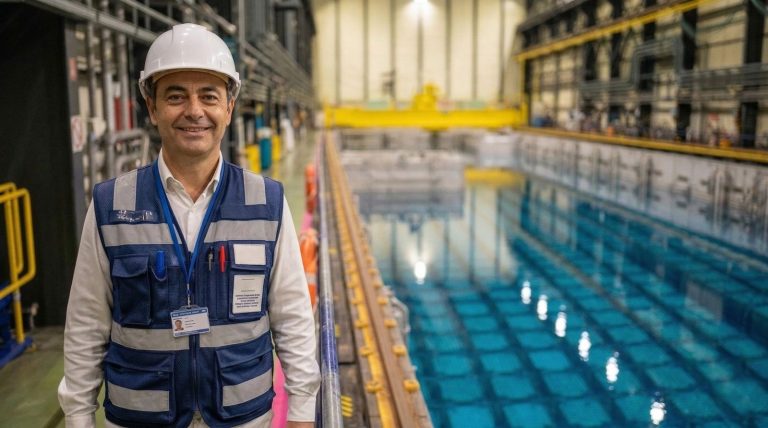
Orano’s most ambitious project remains the “Aval du Futur” (Future Back End), a set of infrastructures designed to modernize the La Hague site, the heart of France’s spent fuel reprocessing operations. This program includes the construction of new storage pools, a plutonium processing workshop, a MOX fuel manufacturing plant (a blend of recycled uranium and plutonium), and, above all, a future reprocessing plant. The latter, estimated at several tens of billions of euros, is crucial for closing the fuel cycle and reducing the volume of radioactive waste to be stored. However, its realization will depend on the lifespan of the current plant, slated for closure around 2040, as well as future political and industrial decisions.
The investments required for preliminary studies and preparatory work already exceed €1.5 billion by 2030. This project is rooted in a circular economy logic, where the recycling of plutonium and depleted uranium reduces the consumption of natural resources. However, this approach presents technological challenges, particularly in isotope separation and the management of ultimate waste. Increasingly stringent safety standards impose strict requirements for containment and traceability, which could further drive up costs. Finally, the issue of waste storage remains unresolved, as the Cigéo project, under development in the Meuse region, faces local opposition and debates over its long-term feasibility.
A bet on the future of nuclear?
The revival of nuclear power in Europe and worldwide presents Orano with a historic window of opportunity—but one fraught with major risks. The success of its strategy will hinge on its ability to innovate, secure its supplies, and control costs in a sector where margins are often slim. The massive investments announced for 2026 and beyond reflect confidence in the long-term viability of nuclear power, but they also expose the group to economic and geopolitical uncertainties. While mining diversification is essential, it must be pursued cautiously to avoid conflicts with local populations and regulators. As for the “Aval du Futur,” it represents an unprecedented industrial challenge, the outcome of which will determine the future of reprocessing in France.
In a context where the energy transition is accelerating, Orano is positioning itself as a key player. The coming years will be decisive: they will reveal whether the group has succeeded in turning this wave of investment into a true industrial renaissance—or whether, conversely, it has embarked on an unsustainable race against risk. One thing is certain: after decades of controversy, nuclear power is back at the heart of energy debates, and Orano will be one of its principal architects.