
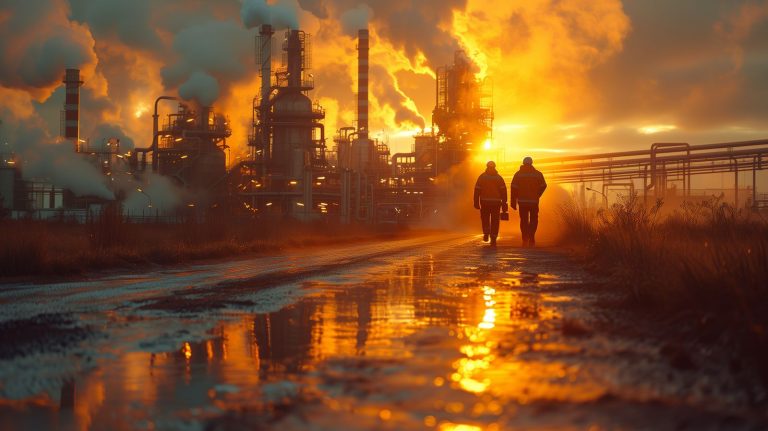
La France is banking on CO₂ capture to decarbonize its industry: between technological hopes and geological limits
The French industry, responsible for nearly 20% of national greenhouse gas emissions, is accelerating its transition toward low-carbon processes. Among the preferred levers, carbon capture and storage (CCS) is emerging as a key solution, despite major challenges. Between colossal investments, regulatory uncertainties, and geological constraints, this technology sparks as much enthusiasm as skepticism. While pilot projects are emerging, particularly in the cement, steel, and aluminum sectors, scientists warn that available storage capacities could prove far smaller than anticipated. A race against time is underway to reconcile industrial decarbonization with economic realities.
An industrial sector under pressure: the urgency of reducing emissions
With 8.5 million tons of CO₂ emitted in 2024, ArcelorMittal’s steel plant in Dunkirk alone accounts for 14% of France’s industrial emissions and 2% of the national total. This underscores the scale of the challenge: how to reconcile massive production with drastic emission reductions? Faced with this complex equation, France is adopting a two-pronged strategy. First, replacing the most polluting processes with low-carbon alternatives, such as electrifying furnaces or using green hydrogen. Second, compensating for residual emissions through carbon capture—a still-emerging technology but deemed essential to achieve carbon neutrality by 2050.
The government recently took a symbolic step by convincing ArcelorMittal to invest €1.3 billion in building an electric furnace in Dunkirk, replacing a traditional blast furnace. A major advance, but insufficient to fully decarbonize the sector. Other industries, such as cement and aluminum, struggle to find viable alternatives to their current processes. For cement producer Vicat, for example, 60% of emissions come from clinker production—a key cement component obtained through high-temperature (1,450°C) firing. Some emissions, deemed "unavoidable," will persist, making carbon capture indispensable.
While promising, this technology remains fragile. It requires costly infrastructure: pipelines to transport captured CO₂ to storage sites, dedicated power lines to power facilities, and above all, massive public funding. Vicat’s VAIA project, which aims to capture all emissions from its Montalieu-Vercieu site, is estimated at between €600 and €700 million. A colossal investment that could double the price of cement, highlighting the need for state and European support. Yet allocated budgets remain limited: of the €1.9 billion earmarked for 2025 under decarbonization project calls, none is specifically reserved for carbon capture. An innovative but risky approach involves selecting projects based on the cost per ton of CO₂ avoided—a kind of "auction" where the most efficient industries will be rewarded.
Technologies in testing, but alarming geological limits
Carbon capture relies on two main technology families. The first, more mature, involves capturing emissions directly from industrial smokestacks (known as "post-combustion"). The second, newer, aims to extract CO₂ directly from ambient air ("DAC," or Direct Air Capture). In both cases, the captured gas must then be transported to geological storage sites, typically former oil fields or deep saline aquifers.
In France, five industrial hubs are under development to concentrate efforts: Dunkirk, Le Havre, Saint-Nazaire, Bordeaux-Lacq, and the Rhône Valley. These strategic zones are expected to host both capture sites, transport infrastructure, and storage reservoirs. Yet a recent study published in Nature challenges the prevailing optimism. According to researchers from Imperial College London and the International Institute for Applied Systems Analysis, the global geological storage potential may be far lower than previously estimated. Applying strict safety criteria (minimum depth of 800 meters to prevent leaks, exclusion of seismic zones or areas near urban centers), scientists estimate the planet could store only 670 gigatons of CO₂—ten times less than earlier projections.
This downward revision stems from several factors. First, geological constraints: suitable sedimentary basins are fewer than imagined, and their capacity is limited by the presence of other gases or geological faults. Second, environmental risks: poorly managed injection could cause CO₂ leaks, endangering local ecosystems and human health. Finally, the location of potential sites favors wealthy nations (Europe, North America), while regions like China or the Middle East—major emitters—have fewer storage capacities.
For France, these limits are particularly concerning. With an estimated capacity of just 10 gigatons, the country will need to make strategic choices. Projects like Vicat’s, which plans to store its CO₂ offshore in Fos-sur-Mer, could face regulatory or technical hurdles. Moreover, offshore storage, though promising, remains experimental and costly. Norway’s Northern Lights project illustrates both the potential and challenges of this approach: after capturing emissions from several European factories, the CO₂ is transported by ship to subsea geological reservoirs. An innovative solution, but one whose scalability remains uncertain.
A precarious balance between innovation and climate realism
Faced with these challenges, industries and public authorities must navigate two imperatives: accelerating decarbonization to meet climate commitments, and avoiding betting on a technology whose limitations could hinder the transition. Carbon capture must not become an excuse to maintain an industry dependent on fossil fuels, but rather a complementary tool alongside other emission-reduction levers.
Several avenues are being explored to optimize this technology. First, improving the efficiency of capture processes. Today, cryogenic or solvent-based methods absorb between 85% and 95% of emitted CO₂, but their energy costs remain high. Research is underway to develop more effective materials, such as polymer membranes or porous solids (MOFs, Metal-Organic Frameworks), capable of capturing CO₂ more selectively and with lower energy use. Next, diversifying uses for captured CO₂. Instead of permanent storage, some projects aim to reuse it, for example to produce synthetic fuels (e-fuels) or construction materials. A circular approach that could ease pressure on storage sites.
Yet these alternatives won’t suffice to offset the scale of industrial emissions. The IPCC has long emphasized that carbon capture can only complement—not replace—drastic emission reductions. Still, in a context where heavy industries (steel, cement, chemicals) struggle to abandon carbon-intensive processes, this technology appears as a lifeline. France, which is banking on five industrial hubs to structure its CCS sector, must therefore balance ambition with pragmatism.
The coming years will be decisive. By 2030, the first pilot projects should enter operational phases, providing valuable feedback. But time is running out: according to climate scenarios, the world will need to capture between 5 and 10 gigatons of CO₂ annually by 2050 to limit warming to 1.5°C. A daunting task, given that current capacities do not exceed 40 million tons per year. Industries, governments, and scientists must therefore innovate rapidly while avoiding repeating past mistakes: a climate transition built on unproven or overly costly solutions.